 Alastic
How to Track and Forecast Prepaid Electricity
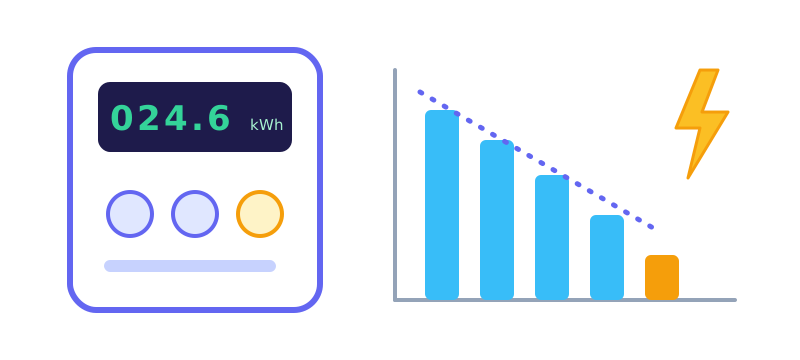
Prepaid electricity puts you in control of what you spend. But it brings one familiar complaint: the credit runs out at midnight, or it seems to vanish faster than last month. The good news is that you can predict when it will run out with simple arithmetic, as long as you know two numbers: the kWh left on the meter and your daily usage.
How many kWh you actually get
The amount you pay does not all turn into energy. Depending on where you live, fees from the vendor and local taxes or standing charges come out first. What remains is divided by your tariff per kWh.
For example, with made-up numbers: you top up 100 units of currency. After fees and taxes, 90 become energy. At a tariff of 1.5 per kWh, you get about 60 kWh. Check your receipt or top-up message for the kWh that was really added, and write it down. From that you can work out your own effective rate.
Reading the balance on your meter
A prepaid meter shows remaining credit, usually in kWh (some show currency). Most meters let you press a button or enter a code to see the balance, and the number falls as you use power. The method differs by brand, so check the instructions on the meter or ask your utility.
The most useful habit is to note the balance at the same time every day, for example right after you wake up. Two consecutive readings are enough to calculate one day of use.
Working out daily usage
The formula is simple:
Daily usage = yesterday's balance − today's balance
If yesterday's balance was 30 kWh and today's is 25 kWh, you use 5 kWh a day. A single day is not representative, because weekends are usually heavier. Take a 7-day average for a steadier figure.
Predicting when the credit runs out
Days left = remaining kWh ÷ daily usage
With 25 kWh left and an average of 5 kWh a day, the credit lasts about 5 days. Top up when the estimate drops to 2 or 3 days, so you are not caught out when shops are closed or the signal is poor. Do not wait for the meter to start beeping.
What uses the most power
An appliance's power is usually printed on its label, in watts. These figures are rough, so check your own devices:
- Air conditioner: roughly 350 to 900 W, depending on size and whether the compressor is running.
- Refrigerator: roughly 100 to 150 W, but not continuously, since the compressor cycles on and off.
- Rice cooker while cooking: roughly 300 to 600 W. Keep-warm mode uses far less.
- Iron: roughly 300 to 1,000 W, only while the element is heating.
- LED bulb: roughly 5 to 15 W each.
To turn watts into kWh, multiply the power by the hours of use and divide by 1,000. An 800 W appliance running for 5 hours uses 0.8 × 5 = 4 kWh.
Making your credit last longer
- Unplug what you are not using, especially chargers and devices with standby lights.
- Set the air conditioner to a moderate temperature and clean its filters regularly.
- Do not leave the refrigerator door open, and let hot food cool before putting it in.
- Iron a batch of clothes in one go rather than a few at a time.
- Replace old bulbs with LEDs.
One thing people often miss: if daily usage suddenly rises for no clear reason, look for a faulty appliance or something left running, such as a water pump with a bad sensor. A daily log helps you spot it sooner.
More guides

How to Check a QR Code Before You Pay
Common fake QR code scams and simple steps to verify a QR code before you tap pay.
How Often Should You Service Your Car or Motorbike?
Typical service intervals for engine oil, filters, brakes and tyres, why time matters as much as distance, and how to keep a simple service log.
Best Before vs Use By: How to Read Food Dates
What food date labels really mean, how long leftovers last, the right fridge and freezer temperatures, and simple habits that cut food waste.